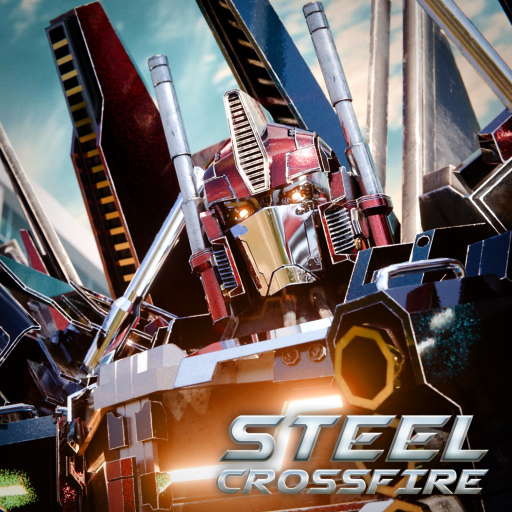
Steel Crossfire Roughcut Guide: Evidence-First Gameplay
Use this Steel Crossfire Roughcut guide to turn roster and gameplay evidence into a live testing plan without inventing stats, price, role, or weapons.
Open the official Steel Crossfire Roblox experience to verify the current live build.
The archived evidence identifies Roughcut as a Reaver and includes a directly relevant gameplay video recorded in Domination on City. It does not provide a structured current Health, Speed, Average DO, price, role, or weapon row for Roughcut. A useful guide must therefore show how to evaluate the character in the live build instead of borrowing numbers from Bastion, Centurion, or Strato.
Establish the profile before judging performance
Open Roughcut's current character entry and record the exact displayed values. Capture the date because character pages and videos can outlive a balance patch. If the interface offers a preview, distinguish preview access from permanent acquisition.
Your profile sheet should include:
- Faction and any displayed role label.
- Current Shard cost or other unlock condition.
- Health, Speed, and every displayed combat metric.
- Primary, Secondary, and transformed or Stealth attacks.
- Vehicle or Jet form and its live controls.
- Character level, skin, event, or temporary modifier affecting the test.
The roster fact supports Reaver membership. It does not prove the rest of the fields. Leaving a cell unknown is more accurate than copying the nearest-looking character.
This gameplay video is directly titled around Roughcut in a Domination match on City. It is valuable for observing decisions and match context, but the score in a video title is one player's result rather than a permanent character stat.
Read the City and Domination context
The community City page describes a relatively small map with similar buildings, a larger grass area in the middle, high ground, and winding turns. It lists a control-point-style mode and Timed Death Match; the video title specifically identifies Domination. Those details give you a framework for reading the footage without pretending every match is comparable.
On City, ask where Roughcut gains or loses space:
- Does the kit control the central open area or prefer building edges?
- How safely can the character approach high ground?
- Does transformation create a clean lane or collide with tight turns?
- Which weapon state is used before entering an objective?
- What is the escape after an aggressive push?
Domination rewards position and timing, not only eliminations. A large kill total can coexist with poor objective value, while a lower total can still reflect effective pressure. Track captures, contests, reinforcements, and survival near the active point alongside combat output.
| Test | Keep constant | Observe | Avoid concluding |
|---|---|---|---|
| Direct engagement | Map lane and target distance | Weapon rhythm, reload, defensive option | One duel proves a universal matchup |
| Objective entry | Same Domination point | Time to cover, exposure, contest value | Kills alone equal objective strength |
| Transformation | Same start and destination | Turn control, boost, exit position | Appearance proves form speed |
| Sustained pressure | Same kit and level | Downtime, ammo, escape reliability | A highlight clip shows average output |
| Budget decision | Current live price | Opportunity cost versus one alternative | Another character's price applies |
Build a repeatable combat loop
Without asserting undocumented weapon names, you can still build the loop from the live kit. Identify which attack starts an engagement, which covers close pressure, and which belongs to the transformed state. Practice each separately before combining them.
A clean test sequence is:
- Use the Primary at its comfortable visible range and record reload downtime.
- Test the Secondary against the same kind of target at the range implied by its live description.
- Transform on a chosen route, not in panic.
- Use the transformed attack only after confirming the firing state and exit.
- Return to Bot Mode before you need direct-combat controls again.
The official Steel Crossfire control scheme lists T for Transform in Bot Mode. Vehicle and Jet forms have distinct movement inputs, so determine which one Roughcut currently uses. Do not assume from the character's predecessor mapping or visual design.
Compare Roughcut fairly
The site has structured profiles for Bastion, Centurion, and Strato, but those are not automatic opponents or benchmarks for Roughcut. To compare, first collect the same live fields for Roughcut. Then choose one shared job: holding a point, approaching a sniper lane, chasing a damaged opponent, or escaping focus.
Keep player familiarity in mind. An experienced Roughcut user in a highlight video can make the character look stronger than a newly purchased alternative. Reverse the test or repeat it across several matches before declaring a winner.
A fair comparison also needs the same match phase. A character tested while a team already controls the center receives safer routes, clearer firing lanes, and more teammate coverage than a character tested during a losing retake. Start the clock from the same spawn or landmark, use the same destination, and record whether Roughcut arrives before, with, or after the team. Repeat the route on both sides if the map layout or spawn path differs. This separates the character's mobility from the advantage created by the current score and team position.
Avoid collapsing every result into a single rating. Track at least three outcomes: how reliably Roughcut reaches useful range, how long the character can remain effective once there, and whether a safe exit exists after the attack. A kit may be strong at opening pressure but weak at holding ground, or reliable at contesting but poor at chasing. Those are actionable findings even when the archived sources do not expose enough structured data for a numeric tier placement.
Use cost as opportunity cost, not power score. If Roughcut's live price is higher than another option, ask what additional job the kit performs. If lower, do not assume it is weak. The archived evidence deliberately does not state a price.
Community predecessor documentation maps Bonecrusher to Roughcut. That connection can help identify older searches and clips, but an earlier kit is not a current Steel Crossfire specification. Verify present names and behavior.
Turn observations into useful notes
Good notes describe conditions. “Roughcut felt bad” is hard to test. “On City Domination, the route across the central grass left me exposed before I could enter the weapon state” points to a route, timing, or kit issue.
After each match, write:
- Mode, map, character level, and current patch date.
- One engagement range that felt reliable.
- One transition that created unnecessary exposure.
- One objective action the kit supported.
- One live field that changed from an older guide.
- One controlled adjustment for the next match.
Do not turn temporary event boosts, teammate support, or unequal levels into base-character conclusions. If the UI displays a modifier, include it in the note.
Save the final note as a dated snapshot rather than a permanent verdict. When a later patch changes a weapon description, form behavior, cost, or map route, repeat only the affected tests and keep the old entry for comparison. This produces a useful Roughcut change log without implying that an older video or community roster remains mechanically current forever.
Frequently asked questions
Which faction is Roughcut on?
The archived community roster lists Roughcut with the Reavers.
What are Roughcut's current stats and price?
The structured evidence does not provide them. Read the current character card and do not substitute values from another Reaver or predecessor version.
What form and weapons does Roughcut use?
Those exact fields are not resolved here. Inspect the live loadout and test the transformation using the current controls.
Is Roughcut strong in Domination?
Relevant gameplay footage exists, but one match cannot prove universal strength. Evaluate objective entry, contest time, pressure, survival, and route fit on the current map.